
Moody's on Thursday said the new 'inflation targeting' mechanism is a "credit positive" move.

Fitch Solutions sees RBI keeping benchmark interest rates unchanged during the fiscal to March 2022 following its decision to buy Rs 1 lakh crore of government bonds. "We had initially expected another policy rate cut to arrest the rise in government bond yields since the Union Budget announcement in February. "However, having an explicit bond purchase guidance from the RBI following the announcement of the G-SAP will also achieve a similar effect, if not even be more effective than a rate cut on capping the increase in bond yields," it said in a note. The Reserve Bank of India (RBI) held its policy repurchase (repo) rate unchanged at 4 per cent at its monetary policy meeting on April 7.

All that you must know about the pros and cons of gift deeds, tax implications, essentials, documents required, conditions, etc...

Average policy rate over the next three years should be around 7.4%

EPS has had its way on most things, alliance-wise. A week earlier, he reiterated that he would not re-admit OPS and Sasikala Natarajan back in the party. It was a message not just to detractors in the AIADMK. It was even more so for the BJP leadership in Delhi. Even more important for the AIADMK was their demand for accepting EPS as the chief ministerial candidate of any alliance that the party would form, observes N Sathiya Moorthy.

Manufacturing activities in India remained robust and price pressures were contained in October as new orders and production rose at a slower but stronger pace, according to a monthly survey released on Tuesday. The seasonally-adjusted S&P Global India Manufacturing Purchasing Managers' Index (PMI) was up from 55.1 in September to 55.3 in October. The October PMI data pointed to an improvement in overall operating conditions for the 16th straight month.

Reserve Bank Governor Shaktikanta Das on Wednesday said in the wake of appreciating US dollar, the movement of rupee has remained least disruptive as compared to its peers, and the size of foreign exchange reserve is comfortable. On a financial year basis (from April to October 2022), the rupee has appreciated by 3.2 per cent in real terms, even as several major currencies have depreciated, he said while announcing the latest set of bi-monthly monetary policy. "The story of the rupee has been one of India's resilience and stability," the Governor said while pointing out that the appreciation of the US dollar this year, which precipitated large-scale depreciation of all major global currencies including the Indian rupee, has drawn wide attention.

Consensus remained elusive on a common BRICS currency as business leaders from the five-bloc nations debated the pivotal issue at a business forum on the periphery of a summit of the five-member bloc being hosted here by South Africa. In their two addresses at the Summit so far, the leaders of Brazil, Russia, India, China and South Africa have made no or scant references to the issue either. "The BRICS Business Forum discussed the international payments system in detail. "Participants also debated the question of whether a BRICS currency is possible or desirable, with strong views expressed both for and against and little consensus reached," Sim Tshabalala, chief executive of Standard Bank Group, told several hundred captains of industry from the partner countries and over 40 other nations across the globe at the Summit.

Reserve Bank Governor Shaktikanta Das on Wednesday said the decision to tweak policy rates was not in his hand as he himself is driven by the situation on the ground. In April, the Reserve Bank in a surprise move hit the pause button and decided to keep the key benchmark policy rate at 6.5 per cent. Prior to it, the Reserve Bank of India (RBI) was on a rate hiking spree, raising the repo rate by 250 basis points since May 2022.
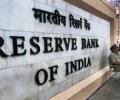
The Reserve Bank of India is likely to cut policy rates by 0.25 per cent and keep the cash reserve ratio unchanged at its policy review next week, on the back of slower-than-expected growth and more encouraging inflation readings, says a report by HSBC.

Foreign portfolio investor (FPI) flows into India may remain tepid in 2022, said a recent note by Goldman Sachs, who now peg the foreign portfolio investment into India at $5 billion in 2022, down from their earlier forecast of $30 billion with risks skewed to the downside. "There has been $15 billion of equity outflows YTD in India already, and the IPO of the largest insurance company has been pushed out. "Additionally, with no mention of India's inclusion in global bond indices in the Union Budget, there are risks to our already conservative base case assumption of an announcement of India's likely inclusion into the GBI-EM Global Diversified Bond Index in Q4-2022," wrote Andrew Tilton, Goldman Sachs' chief Asia-Pacific economist in a co-authored report with Santanu Sengupta and Suraj Kumar.

After raising interest rate by a cumulative 250 basis points in 11 months, the Reserve Bank of India (RBI) on Thursday unexpectedly kept benchmark rate unchanged as global banking woes added uncertainty to the economic outlook. Five out of six members of MPC voted to remain focused on the withdrawal of accommodation to ensure inflation aligns with target while focusing on growth, RBI Governor Shaktikanta Das said on Thursday. The Monetary Policy Committee of the central bank decided to take a pause after a rate hike seen in previous six consecutive policies.
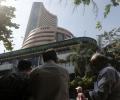
Financials emerged as the top gainers while auto shares rallied on robust September sales

Ahead of the monetary policy review, RBI governor D Subbarao is expected to meet Prime Minister Manmohan Singh and finance minister Pranab Mukherjee on October 23.

The country's gross domestic product (GDP) is likely to grow more than 9.5 per cent in fiscal 2021-22, an SBI research report-Ecowrap said. The economy grew at 8.4 per cent in the second quarter of the current fiscal, according to data released by the National Statistical Office (NSO) on Tuesday. The growth in the April-June quarter of this fiscal stood at 20.1 per cent. In October's monetary policy review, the Reserve Bank of India had retained its projection for real GDP growth at 9.5 per cent in 2021-22, consisting of 7.9 per cent in Q2; 6.8 per cent in Q3; and 6.1 per cent in Q4 of 2021-22.

Rate sensitive shares led the decline ahead of RBI monetary policy review tomorrow.

'The nominal GDP growth assumption for FY25 may be revised upwards on higher growth expectations.'

'Recent underperformance notwithstanding, equities should constitute a major part of investors' financial portfolio.'

Reserve Bank Governor Shaktikanta Das on Thursday said about 50 per cent of Rs 2,000 notes in circulation has come back in the banking system since the RBI announced withdrawal of the highest denomination currency last month. As on March 31, 2023, he said, Rs 2,000 notes worth Rs 3.62 lakh crore were in circulation. "So far, Rs 1.80 lakh crore have come back after the announcement," he said during an interaction with media after releasing the bi-monthly monetary policy here.

The increase reflects a quarter-on-quarter increase of 2.6 per cent in October-December 2022-23. In absolute terms, the total liabilities, including liabilities under the 'Public Account' of the government, jumped to Rs 1,50,95,970.8 crore at the end of December 2022.

Observing that there is liquidity overhand of Rs 13 lakh crore in the system, RBI Governor Shaktikanta Das said on Friday that the exceptional measures undertaken during pandemic will be dealt in sync with macroeconomic developments to preserve financial stability. Since the onset of the pandemic, the Reserve Bank has maintained ample surplus liquidity to support a speedy and durable economic recovery, he said while announcing the outcome of the Monetary Policy Committee (MPC) meeting. The level of surplus liquidity in the banking system increased further during September 2021, with absorption under fixed rate reverse repo, variable rate reverse repo (VRRR) of 14 days and fine-tuning operations under the liquidity adjustment facility (LAF) averaging Rs 9 lakh crore per day as against Rs 7 lakh crore during June to August 2021, he said.


The final and most significant reset in the relations between the government and the RBI is the manner in which the process of appointing the governor and deputy governors of the central bank has been changed.

Retail inflation declined to a three-month low of 5.1 per cent in January, mainly due to subdued prices of vegetables, fruits and other food items, according to government data released on Monday. The fall indicates that retail inflation is inching towards the Reserve Bank's comfort level of 4 per cent. The Consumer Price Index (CPI) based inflation was on the rise for two straight months after touching a trough of 4.9 per cent in October 2023. In December, it stood at 5.69 per cent.
Focus on inflation, higher CPI projection dampen bond market mood.

Foreign portfolio investors' (FPIs') net investments in the domestic debt market surged in December, marking a 77-month high, that is, since July 2017. According to market participants, this significant uptick in FPI inflows can be attributed to the post-domestic policy outcome and the US Federal Reserve's dovish stance at the December policy. FPI inflows into debt stood at Rs 18,393 crore in December against Rs 14,106 crore in November, according to data on the National Securities Depository Limited.

Three years after India declared its goal to become a net-zero economy by 2070, the policy design for achieving the target has begun, with the NITI Aayog forming dedicated multi-sectoral committees to prepare a transition plan. In 2021, India joined a select group of nations that set a target year for becoming net-zero carbon economy. At COP26 in Glasgow, Prime Minister Narendra Modi outlined a five-pronged 'Panchamitra' climate action target for India and committed to a net-zero target by 2070, joining nations like the US, the UK, and China.
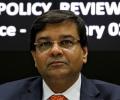
Market participants must appreciate that staying cautious is a virtue for central bankers and should not expect a sudden reversal in the formal monetary policy stance.
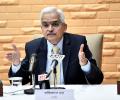
The Reserve Bank of India (RBI) on Wednesday raised the benchmark lending rate by 35 basis points to 6.25 per cent in a bid to tame inflation, which has remained above its tolerance level for the past 11 months. With the latest hike, the repo rate or the short-term lending rate at which banks borrow from the central bank now has crossed 6 per cent. This is the fifth consecutive rate hike after a 40 basis points increase in May and 50 basis points hike each in June, August and September.

In a major decision, the RBI on Friday announced that UPI payment limit to hospitals and educational institutions will be raised to Rs 5 lakh from Rs 1 lakh at present and hiked the cap for e-mandates for recurring payments to Rs 1 lakh. Unveiling the December bi-monthly monetary policy, Reserve Bank Governor Shaktikanta Das said the limit for various categories of Unified Payments Interface (UPI) transactions has been reviewed from time to time. "It is now proposed to enhance the UPI transaction limit for payment to hospitals and educational institutions from Rs 1 lakh to Rs 5 lakh per transaction," he said.
The Reserve Bank of India's rate-setting panel will go for a 0.35 per cent hike in the key repo rate at its meeting next week, an American brokerage said on Wednesday. The hike will be accompanied by a change in the policy stance to "calibrated tightening", Bofa Securities said in a report published ahead of the Monetary Policy Committee (MPC) resolution which is set to be announced on August 5. RBI has hiked the rate by a cumulative 0.90 per cent in two tightening moves in May and June, responding to the runaway headline inflation which has consistently overshot the upper end of the target set for the central bank for many months.
Here is some background on the candidates seen as potential successors to Rajan at the RBI
The wider NSE Nifty too ended 21.55 points, or 0.21 per cent down at 10,476.70.

India's manufacturing sector activities witnessed the strongest rate of growth in three months in July amid improved demand conditions and easing of some local COVID-19 restrictions, a monthly survey said on Monday. The seasonally adjusted IHS Markit India Manufacturing Purchasing Managers' Index (PMI) rose from 48.1 in June to 55.3 in July, pointing to the strongest rate of growth in three months. In PMI parlance, a print above 50 means expansion while a score below 50 denotes contraction.
The declining inflation and a negative industrial outlook have strengthened the case for RBI.
Reserve Bank of India (RBI) Governor Shaktikanta Das had stumped the market in the previous two policies - in August and in October - first with action and then with words. In August, it was the introduction of an incremental cash reserve ratio (I-CRR) to take out excess liquidity, which took the markets by surprise. In October, there was no action. Rather, what is known as "open mouth operation", Das' comment that the central bank might conduct open market operations (OMOs) by selling bonds tempered the euphoria in the bond markets after JP Morgan's inclusion of India in its Emerging Market Bond Index.

A comprehensive technical framework needed, from which a more convincing policy could be demonstrated

India is likely to grow by 7.5 per cent in the first quarter of the current financial year, driven by rising aggregate demand and non-food spending in the rural economy, according to an article in the RBI's May Bulletin released on Tuesday. The Indian economy has demonstrated marked resilience in the face of geopolitical headwinds impacting the supply chain, said an article on the state of the economy published in the May Bulletin.

Analyst are cautious about the performance of IT services sector from January to March quarter (Q4) of FY24 and the first half (H1) of FY25. While the Bloomberg consensus on revenue implies the market is expecting 2-3 per cent growth on a quarter-on-quarter (Q-o-Q) basis for the IT majors through FY25, the H1FY25 is likely to see even flatter returns, and Q4FY24 is likely to be poor. There is likely to be some recovery in the second half (H2FY25) but even so, there's a chance that the market will be overall disappointed.
Subdued prices of food items like vegetables pulled down retail inflation for the third month in a row to 5.3 per cent in August, within the RBI's comfort zone. While the Consumer Price Index (CPI)-based retail inflation declined to 5.3 per cent in August from 6.69 per cent in the same month a year ago, food inflation dipped at a much faster pace to 3.11 per cent from 9.05 per cent in August 2020. The food inflation was also lower than 3.96 per cent in preceding month of July.
